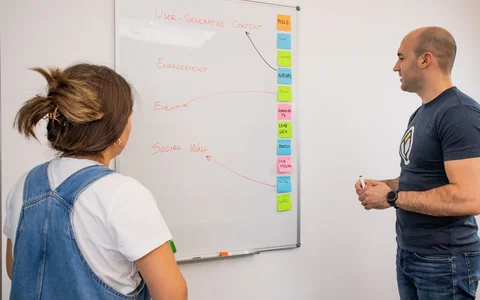
Run a buyer question workshop to agree which decisions customers need help making and which questions your team has evidence for. Ask sales, support and operations to bring specific examples. Give the facilitator a way to separate what a customer actually said from what staff remember and what the team assumes. Finish with a short list of decisions, each with an owner and a next action.
The meeting should produce more than a list of topics. “Bike rental” is a topic. “Can I collect a bike early enough for my group ride?” is a decision with a condition and an intended action. The first belongs in a broad inventory. The second gives a researcher or editor something concrete to check.
Disclosure. AI Visibility is published by Lunasol, which offers GEO and AEO services. The workshop records and rental business below are fictional. The public research guidance and Google Maps post are used as examples. No customer records or new assistant outputs were collected for this guide. About AI Visibility
Set the decision the workshop needs to make
Choose one service and a defined part of the buyer journey. For example, a rental business may want to decide which questions should be answered before someone chooses a collection slot. A facilities company may want to understand what information a customer needs before asking for a site assessment. Give the group a clear finish line such as “select three decisions for the next research round and identify any operational answers we still need.”
Invite people who see different parts of the journey. Sales can describe what customers compare. Support can identify confusion after someone reads a page or opens a form. Operations can explain which conditions actually change fulfilment. The facilitator keeps these contributions distinct. The decision owner agrees which items move into research, content or an operational review. One person may cover several roles in a small company, but the meeting record should still say which judgement they are making.
GOV.UK's Service Manual recommends learning from existing evidence such as analytics, search logs and call-centre data, and testing staff assumptions through user research. Its interview guidance also describes using a discussion guide while allowing useful follow-up. Those principles fit a buyer workshop. Bring actual records where available and use the meeting to identify what still needs to be learned from customers. A staff discussion can organise and interpret evidence, while leaving unsupported claims about customer behaviour open. GOV.UK guidance on learning about users · GOV.UK guidance on in-depth interviews
Ask for examples before the meeting
Give attendees a short collection request. Ask them to bring one or two recent examples where the buyer delayed, compared alternatives or changed their next step. Record the service, channel, approximate date and the condition that mattered. If there is an authorised note or message, retain a reference in the system where it belongs and bring a redacted excerpt or paraphrase into the workshop. Strip out identifying details and use only records the team is allowed to review.
Ask for examples from more than one outcome. Completed purchases can show what helped people proceed. Lost, paused or redirected enquiries can reveal conditions that blocked them. A single channel may overrepresent one stage. For instance, the support inbox may contain post-booking questions while sales calls contain earlier comparisons. Record that coverage. If Arabic enquiries are part of the service but the pre-read contains only English examples, note the gap and assign someone to check it.
Use a simple label for each entry. A documented customer question can point to an authorised record. A staff recollection should say who recalled it and roughly when. A hypothesis should say what would verify it. Keep actual wording separate from a paraphrase and never turn a paraphrase into a direct quote. The evidence label matters later if the same line is proposed as the basis for a published claim about how buyers behave.
Facilitate the session around what happened next
A fictional 45-minute session can start with five minutes on scope and evidence rules. Give people ten minutes to write examples independently before reading them aloud. Use fifteen minutes to group entries and check which conditions change the decision. Spend ten minutes choosing which items to pursue and five minutes reading back owners and next steps. These timings are a suggested agenda. Adjust the number of cases so people can examine the evidence rather than rushing through it.
Ask the contributor what the buyer was trying to do immediately before they asked the question. Then ask what they did afterward. Did they select another option, delay, request a quote or confirm a booking? Where the outcome is unknown, say so. If a colleague supplies a polished question, ask whether it comes from a record, recollection or suggestion. This keeps the most confident speaker from turning a good hypothesis into a supposed finding.
The official Google Maps Instagram reel dated 12 March 2026 illustrates questions with practical constraints, including finding a group meeting place and planning stops. It can be used as a warm-up to show how a place decision changes when someone adds a task. The post is a published product example. It provides no evidence of what a particular UAE buyer asked or how often any question occurs. Give workshop participants a similar distinction between an illustrative prompt and a question drawn from customer evidence. Official Google Maps Instagram reel
When two staff accounts differ, keep both long enough to check scope. Support may say buyers want clearer pickup directions while operations says the form already shows them. The directions might be visible only after booking, which would explain why a person trying to choose a slot cannot see them. Check the exact step and source before deciding whose account to use. A disagreement can identify a research task even when the group cannot settle it in the room.
Group by decision and preserve the conditions that change it
Put together questions that lead to the same action and depend on the same facts. Keep questions separate where a different condition changes the answer. For a fictional Dubai bicycle rental business, one buyer may need to know whether they can collect before a ride and another whether a particular size can be reserved. Both involve availability, but one depends on hours and the other on inventory or allocation. Combining them into a generic availability question would make it harder to identify the useful source.
| Example brought to the workshop | Decision to record | Owner and next action |
|---|---|---|
| A redacted enquiry asks about collection before a morning ride | Can the buyer collect in time for their plan? | Operations verifies earliest collection and where customers can see it |
| Staff recall a rider asking about bike fit but have no record | What does a buyer need to know before choosing a size? | Research checks authorised enquiries or speaks with willing users |
| Support notices a customer thought a request meant a confirmed reservation | What does the confirmation message actually promise? | Booking owner checks the form, message and real process |
| A manager suggests publishing a discount FAQ without buyer evidence | Does discount eligibility block a meaningful decision? | Facilitator records it as a hypothesis and assigns a check |
Ask the group to prioritise by consequence, evidence and relevance to the defined service. A frequent question can justify action if the sample and period are known. A single documented question can matter if the wrong answer would cause a missed booking or other material problem. Record counts with the set they came from. Several people recalling what may be the same enquiry should not create several counted events. When the evidence is weak, rank the value of checking it rather than ranking it as a confirmed buyer need.
Where a question crosses several stages, record the earliest point where the buyer needs the answer. The support team might remember someone asking about a return after paying, while sales recalls the same condition coming up before purchase. The policy can have one owner and source, but the two encounters tell you where the explanation is needed. Ask which stage the workshop was set up to address and give any other issue a separate follow-up. That keeps the current session from growing into a general review of the whole service.
Give each selected question a destination and an owner
Use a short record that can travel to the next meeting or work item.
Buyer question workshop record
Service, journey stage and customer decision
Original wording or labelled paraphrase
Source type, period and evidence reference
Constraint and known next action
Agreed question, owner and destination
Evidence needed next and review date
Decide where each question goes. Some should become research prompts with the original customer conditions preserved. Others should go straight to the web or service team because the correct answer is known and difficult to find. A question with an unresolved policy should go to operations first. Do not hand a writer an unconfirmed answer. Set a named owner and a check date so an unresolved question does not look ready for publication.
A wording change may be necessary for research. Save both the original question and the version you plan to test. If the original named the business and the test is intended to explore unbranded discovery, the change affects what the test measures. Explain it in the record. Keep Arabic and English wording separate where the phrasing or channel changes the buying context, and ask someone with the relevant language and service knowledge to verify the interpretation.
The public AI Visibility guide index covers an initial programme of testing and improving business information. The sales intake workflow can supply notes to this workshop. The workshop adds a cross-team decision about which questions are supported, which should be investigated and who will own the next action. AI Visibility guides and 90-day plan
At the next check, review what happened to each selected item. If operations confirmed a collection time, inspect where a buyer can now find it. If research found only one relevant example, keep its period and source beside the question and leave frequency open. If a new language sample changes the constraint, add a separate record instead of overwriting the original evidence. Retain the cases that changed the team's understanding so the next workshop can start from what was learned.
Read the selected items back before people leave. State what the buyer needs to decide, the evidence the group has and what will happen before the next check. Return any disputed item to its owner with the exact fact or record needed to resolve it. That gives the team a short list it can act on and keeps the rest available as research questions instead of publishing assumptions.