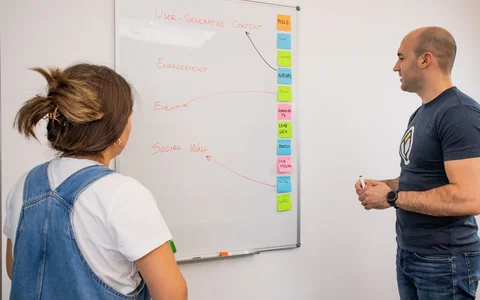
Use the monthly AI search review to decide which issues to fix, which observations to repeat and which changes to record for later. Ask the presenter to bring the underlying examples and the person who can make a decision about each material issue. The meeting is finished when the actions, owners and verification dates are recorded. A slide deck can support that discussion, but the output is a set of decisions the team can follow.
A changed answer can be important when it gives customers a wrong address or misstates a condition for booking. A change in the set of cited links may simply require another comparable observation. Give each case the amount of attention its evidence and customer impact justify. A useful meeting spends its limited time on decisions that would change the work.
Disclosure. AI Visibility is published by Lunasol, which offers GEO and AEO services. The meeting and decision records below are fictional. The platform documents and Instagram illustration are public. No live assistant tests or private client results were used. About AI Visibility
Send a short pre-read built around decisions
Ask the research owner to circulate a short list of items before the meeting. Each one should state the question, why it matters to the business and what decision it needs. Link to the report, the original observations and the primary source that establishes the current business fact. Include the dates and surface. If you cannot reproduce the conditions or the result is incomplete, put that limitation in the pre-read so the team knows what can be decided.
The reporting owner can bring the unchanged prompt set, repeat observations and relevant platform data. The web owner can bring a dated change log. Operations or sales can bring confirmed service conditions and any actual enquiry evidence that bears on the issue. The meeting chair selects the few items needing a decision and asks for a delegate where an owner cannot attend. Avoid asking people to read a full dashboard together when they could spend that time inspecting one consequential case.
The published AI Visibility monthly reporting guide covers the contents of the recurring report, and the broader 90-day plan covers how to build an initial programme. Use the report as a pre-read here. The meeting has a separate task. It converts observations and changes into decisions about the next period. The Scrum Guide describes its Sprint Review as a working session that can change the backlog. That is a useful process example even for a team with a different cadence or method. AI Visibility monthly reporting guide · AI Visibility guides and 90-day plan · The Scrum Guide
Open by checking what can be compared
Start with the period, prompt list and collection conditions. Ask whether any surface, location, language, account setting or definition changed. If the panel added Arabic questions halfway through the month, compare the unchanged subset where feasible and keep the expanded scope visible. Show missing and unattempted observations separately. If a table mixes two products or collection methods, decide which figures must be separated before interpreting a change.
Google's Search documentation says AI Mode and AI Overviews may use different models and techniques and may show different responses and links. An observation that moved from one to the other belongs in a different row unless the meeting is explicitly comparing the surfaces. A single answer can still raise an issue worth checking. The measurement owner should explain which observations support a comparison and which merely tell you what appeared once. Google Search documentation on AI features
For a platform metric, check whether known reporting problems affect the period. Google's Search Console anomaly log records a logging error that lowered reported generative AI Search impressions from 13 to 17 August 2026 and says the missing data was restored on 21 August. If a fictional meeting were using an export saved during that incident, the reporting owner could retrieve the revised figures and note which version informed the decision. The incident concerned a specific report and period. It provides no explanation for an unrelated result. Google Search Console data anomalies
Sort each item by the action the evidence supports
Ask the presenter to show the observation, then the evidence against which it was judged. If an answer gives a wrong phone number and the business confirms that number is published on its own contact page, assign the source correction. The public error is actionable as soon as you establish it. If the answer is wrong but the cited pages appear accurate, assign an investigation with a specific next check. Keep the cause open until you have evidence for it.
If a company or source appeared in one answer and disappeared in the next, examine any comparable repeats and decide how much the change matters. An isolated change may only warrant recording and repeating. A repeated issue affecting a high-value service can justify a closer look at the facts and customer path. Set the condition that would change the decision. “Repeat the same question on the same surface and inspect which source supplies the booking rule” is more useful than “keep monitoring.”
Include relevant external changes without assigning them an effect. The Cycle Hub's official 12 October 2026 Instagram reel points readers to its bio link for group ride details. An editor could use that dated post as a record of public ride promotion when reviewing a change in interest or answer content. The post cannot establish current scheduling or explain a later change in mentions. In a meeting, keep the public announcement in the timeline and verify any current service fact against the appropriate source. Official The Cycle Hub Instagram reel
Use the meeting to choose a short list of work
A 35-minute agenda can suit a small team. Treat these timings as a starting point and adjust for the number of decisions. Use the opening five minutes for scope and missing data, then five for last month's decisions. Spend fifteen minutes on the material cases, using original records rather than summaries where interpretation is disputed. Keep the last ten minutes for agreeing owners, due dates and the evidence needed to close the actions. If the group needs more time to investigate a case, make that the decision and assign it outside the meeting.
Imagine a fictional UAE bicycle business reviewing its rental, repairs and group activity questions. The team has an old branch statement, a changed set of cited links and a request to add another language. The examples below show how it could decide what to do. They do not report results for a real business.
| Item brought to the meeting | Decision | Owner and follow-up |
|---|---|---|
| One answer gives an old pickup address and the same address remains on an owned page | Correct the confirmed public fact | Web editor updates the page and checks the live directions link by the agreed date |
| A single observation changes two cited sources with no clear customer impact | Save the observation and repeat under comparable conditions | Research owner repeats it at the next agreed check and records sources separately |
| A report export is missing days and a reporting notice may apply | Hold the interpretation pending a refreshed export | Reporting owner checks the notice, preserves both versions and returns with the comparable figures |
| Sales asks for a new language because of recurring enquiries | Scope a small separate test if the questions and reviewers are available | Sales confirms the questions and research records the new baseline separately |
| A current booking condition differs across language versions | Confirm the rule and correct each affected public route | Operations confirms the rule and the locale editors verify both live pages |
Require one person to accept each task even if several people contribute. Record whether that person can complete it or needs another approval. A task for the web editor can depend on the operations lead confirming a condition first. Set the dependency date as well as the final check. When capacity is limited, choose the action with the largest likely customer impact and record which investigation is waiting. The next meeting can start with that record rather than reopening the entire discussion.
If the meeting reaches a disagreement, state what would resolve it. Suppose sales believes a booking instruction changed while the web team says the page was updated last month. Ask operations to confirm the policy and the web owner to bring the dated public release. Those are two different facts. The chair can assign both checks with a deadline while leaving the outcome undecided. If the team needs to act before the next monthly meeting, name the approver and schedule a brief follow-up for that item.
Read back the decisions before people leave
Use a shared record with one entry per decision. Separate the reason for the action from the evidence that will close it. The short form below can be copied into a work item or meeting note.
Monthly review decision
Issue and customer question
Dated observation and authoritative source
Decision and reason
Owner, dependency and due date
Evidence required to close
Date for the next review
Read the entry back to the owner. For the example pickup correction, closure evidence is the correct live page and a directions link that reaches the approved destination. The next assistant observation belongs in a separate line of the record. A team can close the website task while still observing the external answer. This distinction keeps an editorial fix from waiting indefinitely for another system to change.
Record items that received no action as well. A note that says “repeat in the same panel before changing copy” prevents another colleague from treating the observation as a confirmed defect. If the team decided that a comparison cannot be made, explain why and record the new baseline when there is one. That lets the next presenter carry forward the correct denominator and avoid quietly mixing the two periods.
Start next month by checking what the team closed
Open the following meeting with the prior decisions and their evidence. Check which actions were completed, which have a new dependency and which need escalation. Ask whether the customer-facing facts changed as intended. Review any new answer observations separately and keep their conditions with them. If an issue was closed because the team verified a route, record where that proof lives. If a task is overdue, decide who can unblock it and when they will report back.
Review the meeting itself every few cycles. Compare the time spent with the number and type of decisions made. If the same uncertain chart dominates, ask what new evidence would make it actionable or move it into the pre-read. If staff keep finding the same operational errors, assign a maintenance owner and a trigger for checking those facts between meetings. Where no material issue needs a group decision, send the evidence and close eligible items asynchronously.
The durable record is the connection from the observation to the source, decision, owner and verification. Keep that connection intact when a slide deck is replaced or a dashboard changes. The following month can then start with what the team actually changed and what it still needs to learn.